

Checking your transmission fluid is the cheapest insurance you’ll buy. Five minutes now can prevent $2,000–$5,000 in repairs later. Most drivers ignore it until the gears start slipping — by then, the damage is done.
This is basic owner maintenance, like checking your tire pressure. If your car has a dipstick, you can do it yourself. If it’s a sealed modern transmission, you’ll know when to stop and head to a shop instead of guessing.
What you’ll need
Tools:
- Lint-free rag or paper towels
- Flashlight (if your engine bay is dark)
Materials:
- Your vehicle’s owner’s manual (for fluid spec and dipstick location)
Prerequisites:
- Car parked on level ground
- Engine warm but turned off (5-minute cooldown after driving)
- Handbrake engaged
Before you start
Check your owner’s manual first. Many 2010+ automatics and most CVTs are sealed — no dipstick. You’ll see “dealer service only” for fluid checks. If that’s your car, skip the DIY and book an inspection ($100–$150 diagnostic fee). Sealed transmissions require a lift and scan tool.
Manual transmissions: Most have no dipstick. Checking fluid means jacking the car, accessing a fill plug on the transmission case, and checking by feel — not beginner-friendly. Take it to a shop.
All-wheel drive: Some AWD vehicles have a transfer case with separate fluid. Don’t confuse it with the transmission. Consult your manual.
Safety note: Transmission fluid runs 150–200°F when warm. Let the engine cool for 5–10 minutes after shutoff to avoid burns. Never check while the engine is running — hot fluid can spray out.
Step 1: Park on level ground and locate the dipstick
Park the car on a flat, level surface. A slope throws off the reading — you’ll think you’re low when you’re not, or vice versa.
Engage the handbrake. Shift to Park (automatic) or Neutral (some older automatics specify Neutral for checking; check your manual).
Pop the hood. The transmission dipstick is usually near the center or passenger side of the engine bay — a looped handle, often red or yellow. It’s typically shorter and closer to the firewall than the engine oil dipstick. If you can’t find it, check the owner’s manual diagram or look for a label on the handle that says “ATF” or “Trans Fluid.”
No dipstick? You have a sealed transmission. Stop here and book a dealer fluid inspection.
Step 2: Pull, wipe, reinsert

Pull the dipstick straight out. Some wiggle; don’t force it.
Wipe the entire stick clean with a lint-free rag or paper towel. You want a fresh reading, not whatever splashed up during your last drive.
Push the dipstick all the way back in until it seats. You’ll feel resistance when it bottoms out — don’t jam it, just press until it stops.
Step 3: Pull and read the level
Pull the dipstick out again and hold it horizontally under good light.
Look for the fluid level between the MIN and MAX marks (also labeled “Cold” and “Hot” on some sticks — use the “Hot” marks if the engine is warm).
Between MIN and MAX: You’re good.
Below MIN: Top up (see Step 5).
Above MAX: Overfilled. This causes foaming, overheating, and seal damage. Drain excess at a shop — don’t ignore it.
Step 4: Check the color and smell
This is where you catch trouble early. Dip a clean paper towel in the fluid on the stick and inspect.
| Condition | Color | Smell | What it means |
|---|---|---|---|
| Healthy | Bright red or pink, clear | Mild, not sweet | Keep checking monthly |
| Aging | Dark red, brownish | Slight mustiness | Plan a fluid service per your manual (typically 60k–100k miles) |
| Overheating | Dark brown or black | Burnt, acrid | Transmission is running hot; check for leaks, inspect cooling system, scan for codes |
| Contamination | Milky, cloudy, foam | Musty or sharp | Stop driving. Coolant may be leaking into the transmission — internal failure risk |
| Metal debris | Opaque, gritty feel | Metallic or burnt | Critical. Internal wear; have transmission inspected immediately |
Burnt smell or black fluid is your “stop ignoring this” alarm. At the dealer, that’s a $2,000–$5,000 rebuild conversation. Caught early, it might be a $400 fluid service and cooler line replacement.
Step 5: Top up if low (automatic with dipstick only)
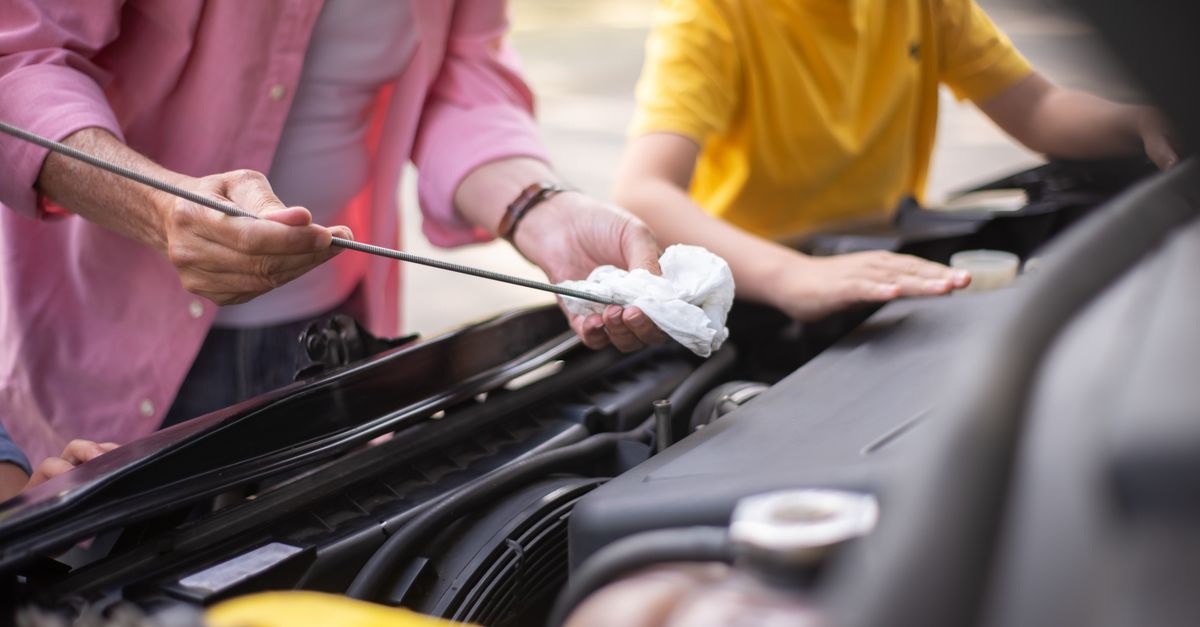
If you’re below MIN, add fluid — but only the exact specification listed in your owner’s manual. Wrong fluid causes slipping, overheating, and seal failure. Examples: Dexron VI, Mercon ULV, Toyota Type T-IV. Don’t guess.
Locate the filler cap in the engine bay (often the same hole as the dipstick, sometimes a separate cap labeled “ATF”). Remove the cap.
Add 1 quart at a time. Wait 2 minutes. Recheck the dipstick (wipe, reinsert, pull). Stop at MAX. A typical top-up is 2–4 quarts; fluid costs $15–$60 per quart depending on spec.
Screw the cap on hand-tight. Wipe the dipstick clean, reseat it, and you’re done.
Verify it worked
Start the engine and let it idle for 2 minutes. Shift through Park, Reverse, Neutral, Drive, and back to Park (this circulates the new fluid).
Shut off the engine, wait 1 minute, and recheck the dipstick. Level should be steady between MIN and MAX.
If the level drops again within a week, you have a leak. Don’t top up and ignore it — leaks don’t fix themselves and low fluid kills transmissions.
Troubleshooting
Problem: Dipstick reads low even after topping up
You have a leak. Common culprits: pan gasket, cooler lines, torque converter seal. Have it inspected before the transmission overheats. A $200 seal replacement beats a $3,500 rebuild.
Problem: Fluid is foamy or bubbling on the dipstick
Overfilled, or air is getting into the system (worn seal, internal leak). If you didn’t overfill, take it to a shop — air in the fluid causes erratic shifts and overheating.
Problem: Can’t find the dipstick
Check the owner’s manual. If it says “sealed transmission” or “no dipstick,” you’re done — dealer service only. Some sealed boxes have a sight glass on the transmission case (visible from underneath with the car on a lift). That’s not a DIY check.
Problem: Fluid smells burnt but level is fine
Transmission is overheating. Possible causes: clogged cooler, slipping clutch packs, towing beyond capacity, aggressive driving. Have the transmission scanned for fault codes and inspect the cooling system. Don’t wait — burnt fluid is friction material breaking down.
When to call a professional
Stop DIY-ing and take it to a transmission specialist if:
- Fluid is black, smells burnt, or has metal shavings (internal wear; don’t drive it hard).
- Fluid is milky or foamy and you haven’t overfilled (coolant contamination or air intrusion).
- Level drops repeatedly even after topping up (active leak; find it before the pump runs dry).
- Your car has no dipstick and the manual says “dealer service only” (sealed transmission; you can’t check it at home).
- You’re driving a manual transmission (checking fluid requires jacking the car and accessing a fill plug — not beginner-safe).
A transmission flush or “preventive service” upsell is common at quick-lube shops. If your fluid is clean and at level, a flush isn’t urgent. Check your owner’s manual service interval first. Most modern ATF is rated for 60k–100k miles; some synthetics go longer. Don’t let a shop sell you a $200 flush at 30k miles if your manual says 60k.
FAQ
Can I check transmission fluid while the engine is running?
No. Most manufacturers specify engine warm but off for accurate readings. Running engines can spray hot fluid when you pull the dipstick, and the reading won’t be accurate. Let the engine idle for 5 minutes, shut it off, wait 1–2 minutes, then check.
What color should transmission fluid be?
Bright red or pink when new. Dark red or brown means it’s aging (plan a service). Black or burnt-smelling means overheating or breakdown — have it inspected. Milky or cloudy means contamination (coolant leak or water intrusion) — stop driving and call a shop.
Do all cars have a transmission dipstick?
No. Many automatics from 2010 onward are sealed — no dipstick. CVTs (common in Honda, Nissan, Subaru) and some luxury brands (BMW, Audi) require dealer service for fluid checks. Check your owner’s manual. If it says “lifetime fluid” or “sealed unit,” you can’t check it yourself.
How often should I check transmission fluid?
Monthly, or before long trips — same cadence as checking your oil. Every 30k–60k miles, take a closer look at color and smell to catch aging fluid early. If you tow, drive in mountains, or live in extreme heat, check every other fill-up.
What happens if transmission fluid is low?
Slipping gears, delayed shifts, harsh engagement, overheating. Low fluid starves the pump, which kills internal clutches and bands. A $20 quart of fluid now vs. a $3,000 rebuild later — the math is obvious.
Transmission fluid doesn’t get the respect it deserves until it’s too late. Check it monthly, top it up when it’s low, and watch the color. If it’s black or burnt, don’t wait for the gears to slip — that’s the sound of your wallet opening.
For broader maintenance timing, see Car Maintenance Schedule by Mileage: What’s Real vs. Upsell. If you’re already hearing rough shifts or delays, check Transmission Repair Costs: Automatic vs Manual Explained to know what you’re facing before the shop gives you a quote.
General information, not professional mechanical advice. Transmission fluid specifications, service intervals, and checking procedures vary by make, model, and year. Always consult your owner’s manual and a qualified technician for vehicle-specific guidance.