

Skip a $150 alignment today and you’ll likely spend $200-$400 replacing tires that wore out 25–50% faster than they should have. I’ve tracked this across three vehicles and multiple tire sets—the math is clear, and it’s not what most shops tell you.
The short answer
Most drivers should check alignment once a year or after hitting a major pothole, not the generic “every 6,000 miles” interval shops push. A 2-wheel alignment costs $75–$150; 4-wheel runs $100–$250. Pay it now or pay double in premature tire replacement—there’s no third option.
What alignment actually costs
The price depends on your vehicle and where you live, not how badly you need it.
National averages for 2024–2026 (per Edmunds and Kelley Blue Book service data):
- 2-wheel alignment (front wheels only, most FWD cars): $75–$150
- 4-wheel alignment (RWD, AWD, performance vehicles): $100–$250
- Luxury/specialty vehicles (BMW, Audi, Mercedes): $150–$400+
- Dealership premium: add 15–30% to those numbers
Regional variation is real. In San Francisco or New York, expect $120–$200 for a standard 4-wheel alignment. In suburban or rural areas, $75–$130 is common. The difference isn’t shop gouging—it’s labor costs, shop density, and the fact that pothole-heavy cities generate more alignment business.
The true cost of skipping alignment
Misalignment accelerates tire wear significantly. Run the numbers:
- Mid-range tire set: $600 (4 tires, installed)
- Expected lifespan: 50,000 miles under normal conditions
- With 30% wear acceleration from misalignment: you get 35,000 miles instead
- Cost per mile: $0.012 aligned vs. $0.017 misaligned
- Extra cost over 50,000 miles: roughly $250 in premature tire purchases
A $150 alignment check once a year costs less than replacing one tire early. I’ve seen outer-edge wear consume 25% of tread depth in 12,000 miles on a misaligned Honda Civic—the tire shop suggested rotating them, but the real fix was $120 and took 45 minutes.
For a detailed breakdown of what tires cost by size and brand, see Tire Replacement Cost by Size and Brand: Real Numbers.
How often you actually need alignment

The “every 6,000 miles” guideline you’ll see online applies mainly to taxis and delivery vehicles—high-mileage, heavy-use cases. Private owners follow different triggers.
Check alignment immediately after:
- Hitting a major pothole, curb, or road debris
- Suspension work (shocks, struts, control arms, springs)
- Collision repair involving wheels or undercarriage
- Seasonal tire changes in regions with harsh winters (pothole season)
Check alignment annually if:
- You drive on well-maintained roads with minimal obstacles
- You haven’t noticed symptoms (pulling, vibration, uneven wear)
- It’s been 12 months or 12,000 miles since your last check
Check alignment twice a year if:
- You live in a pothole-heavy city or drive on aging infrastructure
- You frequently drive gravel, dirt, or rough terrain
- You’ve replaced tires recently and want to protect the investment
AAA’s recommended maintenance schedule suggests annual checks as a baseline, with event-triggered checks for the situations above.
What misalignment looks like
You’ll feel it before you see it, but the tire wear tells the full story.
| Symptom | Likely Cause | Tire Wear Pattern | Action |
|---|---|---|---|
| Vehicle pulls left or right | Toe or camber misalignment | Uneven edge wear—one side of tread wears faster | 4-wheel alignment |
| Steering wheel off-center by 3°+ when driving straight | Toe or caster issue | Center tread even, edges wear unevenly | 4-wheel alignment |
| Vibration or shimmy at highway speeds | Severe misalignment or wheel imbalance | Scalloped or patchy wear across tread | Check balance AND alignment |
| Squealing or scuffing during sharp turns | Camber or caster problem | Wear concentrated on inside or outside shoulder | Check suspension geometry |
| Uneven wear between front-left and front-right | Asymmetric toe-in | Outer edge on one tire, inner edge on the other | 2-wheel alignment minimum |
The steering wheel test is the easiest: on a flat, straight road with no wind, let go of the wheel briefly (safely). If the car drifts noticeably in under 3 seconds, you have a problem. If the steering wheel sits more than a few degrees off-center while driving straight, same deal.
Tire wear develops slowly. By the time you notice feathering on the outer edge, you’ve already lost thousands of miles of tread life. That’s why the annual check matters even when the car feels fine.
2-wheel vs. 4-wheel alignment
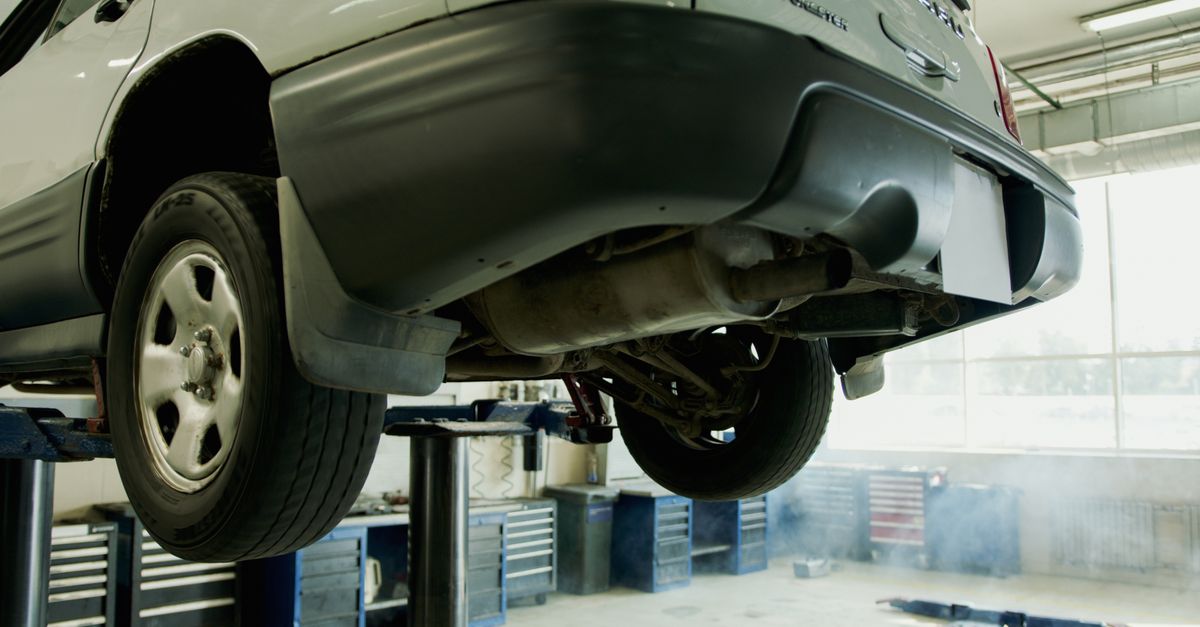
Most front-wheel-drive cars only need the front wheels aligned—that’s the 2-wheel service. Rear-wheel-drive, all-wheel-drive, and performance vehicles benefit from 4-wheel alignment because the rear suspension geometry affects handling and tire wear.
If your car has independent rear suspension or you’ve noticed rear tire wear, spring for the 4-wheel alignment. If it’s a basic FWD sedan and the rear tires look even, 2-wheel is fine.
Shops will sometimes push 4-wheel alignment on FWD cars because it’s more profitable. Ask whether your vehicle has adjustable rear suspension. If it doesn’t, you’re paying for measurements the shop can’t change.
When worn suspension complicates alignment
Alignment adjusts angles—camber, caster, toe—within the suspension’s existing geometry. If your ball joints, control arm bushings, or tie rod ends are worn, the alignment won’t hold. The shop will tell you this after putting the car on the rack.
Budget for this possibility: ball joint replacement runs $150–$400 per side; control arms run $200–$600; tie rod ends are $100–$300. You can’t skip these and expect alignment to stick.
If you’re hearing clunking or knocking over bumps, address that before paying for alignment. Suspension Noise and Repair Costs: Struts vs Control Arms covers when noise means worn parts vs. something simpler.
FAQ
Can I drive with misaligned wheels?
Yes, but every mile accelerates tire wear and handling degrades. If you’re pulling hard to one side or the steering wheel is 10°+ off-center, get it checked within a few days. Mild misalignment can wait a week or two, but don’t let it drag into months.
Does alignment improve fuel economy?
Marginally, if at all. Severe misalignment increases rolling resistance, but the fuel economy impact is under 1% in most cases. The tire-wear cost is the real issue, not the fuel cost.
Is alignment covered under warranty?
Rarely. Most new-car warranties exclude routine maintenance like alignment unless the misalignment is caused by a defective part. Some tire shops offer free alignment checks (but not corrections) as a loss leader.
How long does an alignment take?
45 minutes to an hour for a standard 4-wheel alignment at a competent shop. If they finish in 15 minutes, they probably only checked the front or skipped adjustments. Alignment requires measuring, adjusting, re-measuring, and road-testing—it’s not a quick scan.
Alignment is the maintenance task that pays for itself in tire life. Check it annually, check it after hitting obstacles, and watch for pulling or off-center steering. The shops that push 6,000-mile intervals are overselling, but the shops that say “you’ll feel it when you need it” are underselling—by the time you feel it, you’ve already burned through tread you can’t get back.
General information, not professional mechanical advice. Vehicle maintenance needs vary by model, driving conditions, and regional factors. Consult your owner’s manual and a qualified technician for your specific situation.